“U.S. Dept. of Energy steps up plutonium pit manufacturing at Savannah River Site”
“The site is part of the nation’s effort of “re-establishing capabilities retired after the Cold War,” the national nuclear stockpile plan stated. And also, provide a home for another data center.”
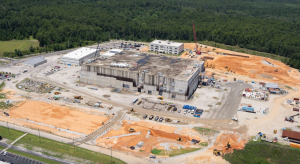
NNSA photo: pit plant, before construction of external buildings.
Jillian Magtoto Savannah Morning News
Story Summary
The Department of Energy is accelerating construction of the new facility, aiming to produce 50 plutonium pits annually by 2030.
While production ramps up, concerns remain about existing radioactive waste and the diversion of funds from cleanup efforts.
More than two hours up the river from Savannah is a nuclear Superfund site, about the size of Augusta just across the border. Despite decades of cleanup, radionuclides still trickle from nearby streams to cow udders, and lurk in the tissues and bones of alligators, hogs, and deer, and the flesh of tadpoles and fish. In July, workers discovered a radioactive wasp hive at one of its hazardous waste tank farms.
The site spanning three South Carolina counties is still active as the country’s only plant extracting and purifying tritium, a radioactive isotope that boosts the efficiency and explosivity of nuclear weapons.
But the Savannah River Site (SRS) is about to be re-awakened to produce plutonium pits, hollow bowling-ball sized spheres of plutonium at the core of warheads that causes the nuclear blast. Plutonium is a heavier metal that, according the Environmental Protection Agency (EPA), can enter the bloodstream upon inhalation, resulting in lung scarring, disease, and cancer. It carries a half-life of about 24,000 years.
Last October, the Department of Energy’s (DOE) National Nuclear Security Administration (NNSA) assumed primary responsibility of the SRS to produce 50 of the country’s 80 annual plutonium pits by 2030. The remaining 30 will be made in the Los Alamos National Laboratory in New Mexico, where plutonium pits were first created in the 1940s.
Over 80 years later, “NNSA is being asked to do more than at any time since the Manhattan Project,” stated NNSA Administrator Jill Hruby at the 2024 Nuclear Deterrence Summit. For SRS, the goal “is aggressive, complete construction by 2032 so that rate production can support the W93 schedule.” W93 is the newest and 93rd nuclear weapon design the U.S. has considered after a 30-year hiatus, planned for deployment by U.S. Navy submarines.
On Sept. 18, it announced the construction of new work fronts to accelerate the buildout of the Savannah River Plutonium Processing Facility (SRPPF) estimated to cost up to $25 billion and hoped for completion by 2030, its press release stated—two years ahead of schedule. A week later, the DOE announced it will host a public information session from 4 p.m. to 7 p.m. at Nancy Carson Library on Oct. 23 before it submits its permit application for the SRPPF’s hazardous waste storage.
“Operation of the proposed SRPPF would generate a variety of wastes (including radioactive, hazardous, mixed, and sanitary) as an unavoidable result of normal operations,” stated the NNSA in 2020—adding to the radioactive waste still sitting in aging, potentially leaky underground tanks.
While plans are accelerating, “most of the public doesn’t even know what’s going on out there,” said Tom Clements, founder of his one-man watchdog website, Savannah River Site Watch, who has monitored the plant since the 1970s. “They don’t know they’re building the pit plant.” And likely, also a data center.
Born for war
The same year former President Harry S. Truman announced a push for atomic energy in 1950, the U.S. Atomic Energy Commission, later known as the DOE, selected the area for E. I. du Pont de Nemours and Company to manufacture nuclear weapon materials tritium and plutonium. With five reactors, two chemical separation plants, a nuclear fuel facility, and more, it manufactured a third of the country’s plutonium for nuclear weapons for nearly four decades.
But as the Cold War sputtered out, so did plutonium production in 1988. A year later, Dupont’s contract ended.
Left behind was 310 square miles of wetlands and pine forests littered with coal ash, landfills, and radioactive isotopes including cesium, uranium, tritium, and strontium, according to the EPA’s Superfund site assessment.
The DOE Office of Environmental Management (EM) took over primary responsibility of the site—a department intended to cleanup the fallout from energy projects—and shuttered plutonium pit manufacturing throughout the ’90s. In 2000, the U.S. and Russia agreed to each dispose of 34 metric tons of surplus weapons-grade plutonium, amounting to 17,000 nuclear weapons. It seemed the deal was sealed.
Plutonium’s pitfall
It’s one thing to stop plutonium production, but it’s an entire other affair to dispose it.
Because weapons-grade plutonium cannot be blended with other materials to render it unusable for weapons, Russia and the U.S. agreed it would instead be made into mixed oxide (MOX) fuel and irradiated in civil nuclear power reactors for electricity. For the U.S., that MOX facility would be housed at the SRS, which began construction in 2007.
But the promise was a far cry from what the DOE was able to do.
Technical issues, delays, and mismanagement reported by outlets like the Post & Courier ended its operations in 2018. In 2022, the MOX building contractor paid $10 million to the DOE for fraudulent invoices for nonexistent materials. If completed, SRS’ MOX facility would have been 32 years behind schedule and $13 billion over budget, according to the DOE.
Meanwhile, the state of South Carolina was growing wary of the tanks sitting on its soils. In 2014, the state sued the U.S. government and six years later, won the state’s largest single settlement of $600 million and the DOE’s commitment to remove all 9.5 metric tons of plutonium from the state by 2037. Until then, South Carolina has waived its right to bring any lawsuit against DOE for plutonium disposal.
So the DOE went with a cheaper and quicker alternative: diluting the plutonium with a plutonium powder into a “more secure” and less weapon-usable form—though the potential of reversibility led Russia to back out of the deal. SRS has undergone a flurry of expansion, automation, tank transport, and construction of mega-sized disposal units all to dilute the plutonium into a Superfund smoothie that gets vitrified into obsidian-like glass and shipped to a waste isolation pilot plant 2,000 feet underground in a New Mexico salt mine, according to SRS. It completed the first shipment in December 2023.
Still, radioactive byproduct remains in 35 million gallons of waste stored in roughly 43 of the original 51 underground carbon steel containers according to most recently published updates this January.
“These tanks have outlived their design lives, posing a threat to the environment,” stated a Savannah River National Laboratory webpage. “Some of the tanks have known leaks.”
A new mission swipes cleanup funds
From aging plutonium pits housed at the Pantex facility in Texas, the SRS will generate new plutonium pits at the SRS unit originally intended to retire weapons-grade plutonium.
The failed MOX facility will be repurposed into “a safe, secure, compliant, and efficient pit production facility,” according to the national nuclear Stockpile Stewardship and Management Plan.
“This is a whole new mission,” said Clements. “They never handled a pit at the Savannah River Site.”
But as the site shoulders the new plan, remediation funds get pulled. When the DOE EM handed over primary responsibility of the site to the NNSA last year, $173 million were reallocated from cleanup to weapons activities and transition costs. And it seems some environmental processes fell though the cracks.
“They basically named SRS as the second [plutonium pit] plant site without doing an environmental analysis,” said Clements. “And that’s we got them for, violating the National Environmental Policy Act.”
In 2021, Clements, the Savannah River Site Watch and a few other plaintiffs sued the DOE and NNSA, resulting in a settlement that will play out over the next couple of years. Until the DOE conducts a Programmatic Environmental Impact Statement (PEIS) examining the environmental impact of other approaches to pit production and reach a Record of Decision filed by July 17, 2027, the DOE will not introduce nuclear material into the SRPPF’s main processing building.
Still, the DOE’s Oct. 23 hazardous waste permit public meeting indicates to Clements that they’re not slowing down.
“I think they want to show that they’re making progress in pursuing the pit plan,” said Clements.
And it’s not just plutonium.
On Sept. 30, the NNSA issued a request for proposal from data centers “interested in a long-term lease” at the SRS, due Dec. 5.
“There’s so much happening,” said Clements. “I think there’s some questionable projects going on that could have great health and environmental impact that people are just not aware about.”
Jillian Magtoto covers climate change and the environment in coastal Georgia. You can reach her at jmagtoto@gannett.com.
This reporting content is supported by a partnership with Green South Foundation, Prentice Foundation and Journalism Funding Partners.