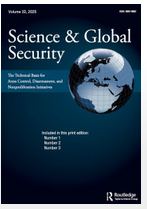
“Consequence Analysis of Major Fires at Plutonium Pit Production Facilities”
Science & Global Security journal, July 10, 2026
https://www.tandfonline.com/doi/full/10.1080/08929882.2026.2690796
Abstract
As the United States reestablishes large-scale plutonium pit production, federal agencies have published environmental impact studies estimating radiological consequences from major facility fires in New Mexico and South Carolina. These analyses predict average latent cancer fatalities in the single digits but do not evaluate total cancers or remediation costs from land contamination. Using atmospheric transport and dispersion modeling, this study independently estimates downwind plutonium deposition and inhalation, cancer risk, and land contamination across meteorological conditions for different source terms. For assumptions consistent with current federal analyses, a 1-kilogram respirable release could produce up to 21 latent cancer fatalities, with total cancers three times higher. Tens of square kilometers of land could require billions of dollars in soil remediation, while contamination in residential areas could require evacuation. Larger releases involving different fire conditions and smaller particle sizes could cause over 1,000 fatalities, suggesting current assessments may underestimate accident consequences.
Conclusion
This study presents a consequence analysis of potential major fires at plutonium pit production facilities at Los Alamos National Laboratory and the Savannah River Site. Using atmospheric transport simulations, it evaluates long term cancers and cancer fatalities, land contamination, and the spatial distribution of affected populations across a range of particle sizes and meteorological conditions. For 5-micron particles, average cancer fatality estimates are consistent with those reported in DOE environmental impact statements, but a wide distribution of outcomes emerge due to weather variability. The analysis indicates that substantial areas of land could exceed established contamination thresholds, with potential remediation costs exceeding those of the Rocky Flats cleanup. Historical evidence from the 1957 Rocky Flats fire suggests that respirable releases may be larger than currently assumed. Accounting for smaller particles and a broader range of fire conditions, estimated latent cancer fatalities could be up to two orders of magnitude higher than current federal evaluations. These findings suggest that existing assessments may underestimate the consequences of major plutonium fires and warrant further analysis.
—–
Comment of SRS Watch for the Draft Plutonium Pit PEIS record, based on the journal article on plutonium fires at the SRS and Los Alamos pit plants, July 15, 2026: PEIS comment Clements questions based on Science and Global Sec article July 15 2026