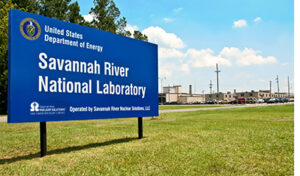
On October 28, 2026, a fire in a lab at the Savannah River National Lab was reported, with at least one worker harmed and radiation released. Here’s our first take on the alarming situation.
Savannah River Site Watch – News Release
Columbia, SC
For Immediate Release
October 31, 2026
Contact: Tom Clements, Director, SRS Watch, tomclements329@cs.com, tel 803-834-3084
Columbia, SC — The reported fire in a facility at the U.S. Department of Energy’s Savannah River Site (SRS) in South Carolina has raised concern about operations at the sprawling nuclear weapons facility due to potential health and safety impacts to workers and reported release of radiation. A quick review of archived documents posted on line by an independent oversight agency, the Defense Nuclear Facilities Safety Board (DNFSB), reveals that fire-suppression issues at the Savannah River National Laboratory (SRNL) have been raised by the Board for more than 6 years.
The 310-square-mile SRS, established by the Atomic Energy Commission (AEC) in the early-1950s, produced plutonium for U.S. nuclear warheads and currently processes all tritium that goes into all U.S. nuclear weapons. SRS has a growing nuclear weapons role and the DOE’s National Nuclear Security Administration (NNSA) is currently retrofitting an existing facility at SRS to produce plutonium “pits” – the core of nuclear weapons – a role SRS had never had. DOE revealed on October 19, 2026 that the cost to prepare the never-used plutonium fuel (MOX) building at SRS to make pits would be an estimated $23.5 billion (which excludes the $5-8 billion sunk into construction of the MOX building). NNSA has said that the schedule for completion of the pit facility has slipped to 2038, raising doubts the project will be completed.
The DNFSB documents – see excerpts below, with URLs – show that the Board was on top of potential fire-suppression and administrative problems at SRNL but that DOE has not fully responded in early 2026 to issues identified and recommendations made by the board in 2023. As DOE and SRS have not revealed in which lab the fire took place – and what radioactive materials were in the lab – nor how it started nor how it was brought under control, it is at the point not possible to determine if DOE’s failure to fully implement fire-suppression recommendations made by the SRNL contractor in 2023, in response to the DNFSB’s recommendations, contributed to the initiation or apparent spread of the fire.
In a February 23, 2026 DNFSB “activity report” (aka “weekly report”) by the Board’s resident inspectors at SRS, it was revealed that some identified fire-suppression deficiencies had not been properly addressed and had not been incorporated into the “safety basis,” which would identify potential hazards and address them both administratively and with actual fire-suppression control systems. The report points out lingering problems and it is unknown if these were later corrected:
After a DNFSB staff review identified several concerns with the approved SRNL safety basis at the time, the Board transmitted a letter to DOE-EM on April 5, 2023. The letter detailed the Board’s concerns with SRNL’s safety- significant fire suppression system (FSS), which utilizes many key components classified as general service. DOE-EM’s response in its August 23, 2023, letter committed to conducting a backfit analysis of the FSS (which was completed in 2024) and to evaluating incorporating any additional measures identified from the backfit analysis into the FY25 update to the safety basis, or as soon as practicable. While some aspects of the Board’s letter have been addressed in the current revision of the safety basis, many of the items identified in the backfit analysis of the FSS remain open and have not been incorporated into the current or upcoming revision to the safety basis. After discussions between the resident inspector (RI), field office, and contractor, the contractor has entered the items identified in the Board and DOE-EM’s letters into its issue-tracking system to ensure actions are appropriately identified and tracked to completion.
Tom Clements, Director of SRS Watch, a public-interest group based in Columbia, SC that monitors nuclear safety issues at SRS, stated the following on learning of the fire, its harm to workers and the apparent release of radioactive materials into the environment:
“DOE must immediately conduct a review of what caused the fire, what impacts it has to public health and safety and to the environment, and what will be done to prevent such fires in the future. Given that fire protection at SRNL has failed, a halt to SRNL technical operations until fire-response protocols can be reviewed and improvements implemented is called for. In particular, DOE must reveal if it had at the time of the fire fully responded to recommendations by the Defense Nuclear Facilities Board concerning fire-suppression problems identified at the Savannah River National Lab and state when new steps will be taken to upgrade fire protection. That SRS is now pursuing a facility that would produce weapons’ pits from plutonium, which can burn when exposed to air, it does not bode well for the pit plant when an unanticipated fire can’t be controlled in a single SRS lab facility. A rigorous review by both DOE and the DNFSB of the status of current fire protection at SRS facilities and fire protection being planned for the SRS pit plant is called for.
###
New release and links to supporting DNFSB documents posted at: Fire at SRS October 31 2026 SRS Watch news