Hold on, Monsieur, we’re not sure your expensive SRS plutonium dreams will survive close examination….
The first attempt to build a plutonium fuel (MOX) plant at SRS failed abysmally and established a new DOE standard for mismanagement, cost overruns and schedule delays. Now, ignoring the massive MOX failure at SRS, a French company called newcleo has unveiled a half-baked proposal to pursue at SRS a new MOX-fabrication plant, MOX-fueled lead-cooled reactors and a reprocessing plant – to remove weapon-usable plutonium from spent fuel.
On September 24, 2026, newcleo made a presentation to the South Carolina Nuclear Advisory Council, a state-sponsored nuclear industry booster group, titled “newcleo Americas in South Carolina – A Key Enabler of Advanced Nuclear Innovation.” The proposal is chocked full of stitched together, costly and technically challenging plutonium and nuclear projects at SRS but the presentation raises more questions than it answers.
Take a close look at page 10 of the presentation (linked above) – the cost estimates just don’t make sense. What does the statement “MOX Factory Investment: $2+ BILLION” mean? The MOX factory at SRS was terminated when the cost estimate by DOE’s Office of Project Management Oversight of it went over $17 billion (with $5-8 billion having been wasted on construction when it was halted in 2018), with “operation starting as late as 2048.” So, they think they can build a MOX factory, even a modular on, in just a few years on the cheap? Or just cheap to them (while others pay the full cost)?
The presentation says “Direct Jobs during Construction: up to 12,000 FTE” (full-time equivalent – jobs) yet it doesn’t say over what period of time that many people would be employed nor how long construction would take. Considering all employee costs, 12,000 FTE for a year or spread out over time more would likely be well more than $2 billion, which wouldn’t include cost of materials.
On the same page, it says “Direct Jobs during Construction: up to 8,000 FTE” for the first lead-cooled fast reactor, with an “investment” of $1.5 billion. This makes no sense as worker costs alone would seemingly be over $1.5 billion.
The slide claims that “newcleo intends to bring to South Carolina” $3.5+ billion. Really? A MOX plant and boutique reactor for $3.5 billion? Sounds like a Walmart special. Or, is the plan to get tax payer subsidies to pay the remaining costs? And, besides producing MOX for the newcleo lead-cooled reacltors just who would buy MOX from the facility? Additionally, the cost of facilities would flow out of South Carolina and not stay here.
The presentation is clear that it would involve the reprocessing of spent fuel – for removal of weapon-usable plutonium to be used as reactor fuel – but who would pay for such a factory? A reprocessing plant could cost $ billions, especially if it was aimed at addressing the 100,00 metric tons of spent fuel stored in the US. And, newcleo would likely find out quickly that people in South Carolina don’t want high-level nuclear waste (spent fuel) imported to be processed, which would leave behind a huge volume of nuclear waste, via PUREX reprocessing. Rather like the huge volume of waste now at SRS now, a byproduct of plutonium production for nuclear weapons.
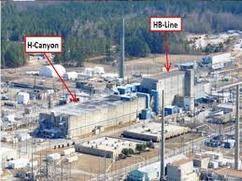
The presentation claims that newcleo would use US Government surplus plutonium to be fabricated into fuel. If the plutonium would be purified at SRS in the HB-Line, where are the safety and environmental and cost reviews for operation of that mothballed facility? The presentation says that “Surplus plutonium is already stored and managed on site under established DOE/NNSA custody,” yet about 10.5 metric tons of plutonium are stored in the old K-Reactor at SRS and half of that is designated to be fabricated into new plutonium pits. DOE aims to give away 19.7 MT of plutonium (to 5 named companies), so where is that plutonium now stored and how would it be transported to SRS and how would it be handled and processed?
The presentation, on slide 8, says that “Oklo, in partnership with newcleo, was selected by the U.S. DOE for advanced negotiations under the Surplus Plutonium Utilization Program, advancing the use of surplus plutonium as reactor fuel.” Yet, Oklo has no reactors of any kind – it has on paper a speculative sodium-cooled reactor called a Powerhouse – but after initially using HALEU it could use a metallic plutonium fuel and not MOX. So, would a newcleo MOX factory also make metallic plutonium fuel?
Additionally, Oklo claims to be pursuing an electrometallurgical form of processing called pyroprocessing, which is totally unproven regarding processing of quantities of commercial spent nuclear fuel. Is newcleo in on this? (BTW, Oklo claims in its August 2026 SEC filing that 2028 is a target date for an Aurora Powerhouse to be operation at DOE’s Idaho National Lab: “We have an ambitious target of deploying our first powerhouse in 2028 amidst a range of supply chain, construction, macroeconomic, and design complexities.” But, as far as we know construction hasn’t even started. Good luck with that! We’ve marked our calendar for 2028 to be in Idaho when the Powerhouse begins operation! Join us!)
Are they hoping that the newcleo reactors will fuel the proposed DC BLOX/Amentum/DOE AI data center at SRS that nobody in South Carolina is clamoring for? Details about that data center are being hidden from the public and DOE has not responded to a FOIA request for the Amentum proposal and the Amentum contract with DOE.
And, newcleo claims it will operate the first lead-cooled reactor “under DOE/NRC licensing.” Uh, DOE is neither a licensing nor a regulatory agency. But under relaxed rules, DOE might rubber stamp construction of a lead-cooled reactor or other reactors on a DOE site, which means there will be inadequate review and oversight and thus protecting public health and safety will be downplayed. People in South Carolina or near DOE or federal property elsewhere will not be thrilled to have unlicensed, unregulated, untested, “advanced” reactors planned near them.
BTW, newcleo stock has fallen like a lead balloon over the last month.
In conclusion: newcleo needs to thoroughly explain what it’s up to and who will pay all costs.
—–
it is anticipated that the initial fuel will be produced from surplus plutonium processed into a usable reactor
fuel form. This approach is being pursued by the Department of Energy (DOE) as a means of rendering
excess Pu stock (both weapon and reactor grade material) into fuel for advanced nuclear reactors. The LFR-
AS-200 is also capable of using MOX fuel derived from reprocessed used nuclear fuel through the processes
currently in use in France. A regulatory engagement plan for newcleo’s fuel cycle-related activities will be
provided in separate correspondence.”